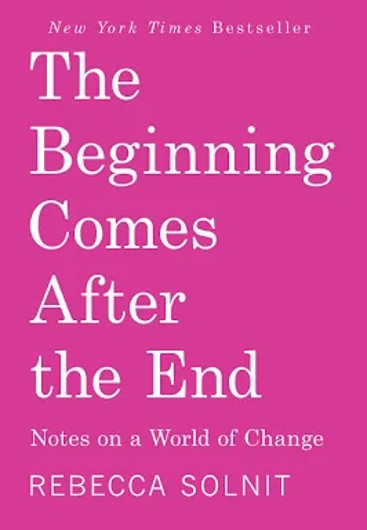
Review of “The Beginning Comes After the End: Notes on a World of Change” by Rebecca Solnit
by Cindy Cole and John M Repp
Rebecca Solnit writes about hope in the face of dystopia and disaster. Her books, Hope in the Dark (2004) and A Paradise Built in Hell (2009) reflect that theme. In her new book she examines our cultural history since the 1955 Montgomery bus boycott. She recounts the steps taken, attitudes changed, laws passed and how they have slowly transformed our current culture. The whole change could be named “from empire to integration.” This book will also give us hope.
“The Beginning” in the title refers to a coming new age that will begin after the many changes our society has undergone since 1955, a little over the 70 years. Most people do not understand how big the change has been. In science or mathematics, to know how large a distance has been traveled, a person needs to have a beginning point, a place to stand to take the measurement. But with recent history, the older generations themselves have been moving, and the younger generations do not know the beginning decades, so many people do not really see how much change has happened.
For one thing, philosophical and religious influences have come from Asia. Buddhism and Hinduism expanded to the west in the 70’s and now are widespread. They emphasize kindness, not an afterlife, and many Americans are practitioners of mindfulness and other forms of meditation. More and more we are coming to see and respect the Native American indigenous ways stressing interconnectedness, relationship and the essential, omnipresent nature. Solnit opens the book describing a ceremony she attended where land was given back to a native tribe.
North American indigenous peoples respect nature and see all life as sacred. The old ways of our native people can show us ways to a new beginning. The Environmental Movement, also beginning in the 70’s, has changed society and now many of us look at how we can participate in making the planet more livable. Climate change is real to most Americans.
Jane Goodall’s research showed us that humans have a lot in common with our animal friends. Science has shown that the human body is made up of millions of bacteria cells in addition to our own cells. Bacteria and fungi, bugs and worms are essential to our ability to live. Complex life is symbiotic and cooperative. Lynn Margulis affected a paradigm shift of our understanding that complex cells i.e. cells with a nucleus, evolved from the merger of formerly independent free-living bacteria, in the same way, that multiple cellular plants and animals evolved from one-celled creatures.
The Civil Rights movement and the women’s liberation movement had great impact on ideas and laws based on diversity, equality and inclusion (DEI). The LGBTQ+ movement has made great strides, Our youth are much more open to gender fluidity.
Solnit stresses, however, that the backlash against these new ideas and ways of being has been and is fierce and violent. That backlash supplied the strength of the Trump-led “make America Great” movement. That movement has been described by Anand Giridaharadas, author, as “a revolt against the future”. Cruelty happens when inequality and entitlement are dominant.
Over time, hierarchies have been loosened that separated people: White over black and brown, men over women, straight over queer, etc. The backlash is about putting people back in their “proper” places. It is the idea that the wealthy and elites are superior and denying others is justified. Authoritarians claim that this is natural and it plays into the myth so prominent in our American society of the “rugged individual and self-made man”. The new world culture that Solnit sees coming will feature interconnectness rather than separateness or individuality.
The new civilization will be ultimately based on the idea that everyone matters. Indeed many men have accepted feminist ideas. The respect for the indigenous idea of relationship and that humans are a part of nature is becoming dominant. That we need to care for each other and the environment is accepted by many, many people. That freedom needs to be for everyone and that blacks, Asians, Latinos, immigrants, and women do not threaten the freedom of white men and the elites.
Change will continue. Reagan’s policies produced homelessness. California used to have free tuition for college. We can change them back and work to bring the new version of a society into being. We do not know exactly what the future holds but we can decide to form alliances, take action, build bridges and find refuge. And we can ”dismantle what does not serve the broader us and we.”